
Category: Client Stories
Topic: eCommerce VAT / VAT Compliance
Author: Muhammad Haris
Reading time: 5–6 minutes
Introduction
A client came to us earlier this year with a serious VAT problem.
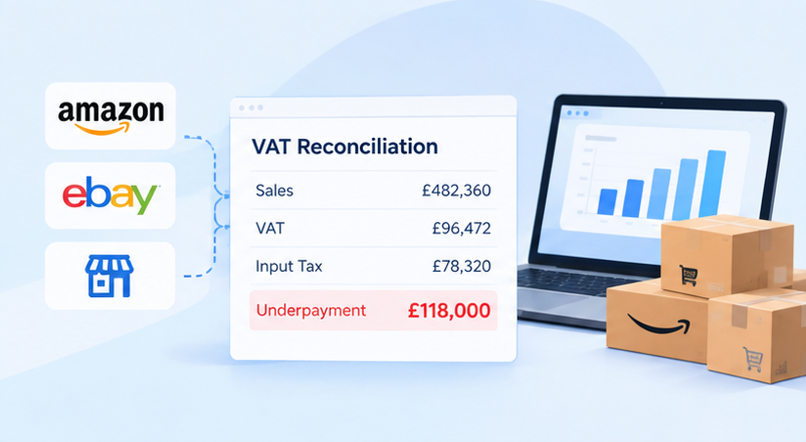
They had underpaid approximately £118,000 in VAT.
It wasn’t fraud. It wasn’t deliberate.
The problem was a combination of processes that hadn’t kept pace with the business.
The company was selling through Amazon, eBay and a physical retail store. From the owner’s perspective, the business was operating normally and VAT returns were being submitted.
But when we reviewed the underlying records, the numbers told a very different story.
This is a useful reminder for VAT-registered businesses:
Submitting VAT returns is not the same as having effective VAT controls.
The Business
The client operated across several sales channels:
- Amazon
- eBay
- a physical shop
As the business grew, its accounting became more complicated.
Each sales channel generated its own records, transactions and reporting.
There were also differences between customer sales, marketplace deductions, bank receipts and the information being used to prepare the VAT returns.
The business had an accountant and VAT returns were being filed.
But the underlying VAT position wasn’t being reviewed in sufficient detail.
Over time, several issues accumulated.
What We Found
When we reviewed the VAT records and underlying transactions, we identified several problems.
- Physical shop sales had not been properly included
Some sales from the physical shop had not been correctly reflected in the VAT records.
This meant that taxable sales were missing from the figures being used to prepare the VAT returns.
- Incorrect VAT rates had been applied
Certain product lines had been assigned incorrect VAT treatment.
Even where individual errors may appear relatively small, repeated errors across multiple transactions and VAT periods can create a significant difference.
This is one reason why VAT treatment should be reviewed when a business sells a wide range of products.
- Ecommerce sales were being recorded from bank receipts
The business was recording ecommerce activity based on the money received into the bank rather than properly accounting for the underlying sales transactions and the relevant VAT treatment.
This is particularly important for businesses selling through online marketplaces.
A marketplace settlement received into the bank is not necessarily the same thing as the underlying customer sales.
Marketplace fees, refunds, adjustments and other transactions can affect the amount ultimately paid into the bank.
Using the bank receipt alone can therefore create problems when preparing accounting records and VAT returns.
The Problem Wasn’t Simply the VAT Return
The important point here is that the problem wasn’t necessarily that VAT returns had not been submitted.
They had.
The bigger issue was what happened before the VAT return was prepared.
If the accounting records going into the VAT return are incomplete or incorrectly classified, a return can be submitted on time while still containing errors.
That’s why VAT compliance needs to involve more than simply meeting the filing deadline.
The underlying records need to support the figures being reported.
Why Ecommerce Businesses Need Extra VAT Controls
Businesses selling through multiple channels can have more complicated accounting processes than a business with a single sales channel.
For example, an ecommerce business may have:
- customer sales;
- marketplace commissions;
- payment processing fees;
- refunds;
- discounts;
- adjustments;
- fulfilment charges;
- advertising costs;
- imports;
- import VAT;
- multiple sales channels; and
- different VAT treatments for different transactions.
The amount reaching the business bank account may therefore be significantly different from the value of the underlying customer sales.
This is why simply reconciling bank deposits may not provide a complete picture of the business’s VAT position.
Growth Can Expose Weak Processes
One of the most common themes we see in growing businesses is that the business itself develops faster than its accounting processes.
A system that works when a business has a relatively small number of transactions can become unreliable as sales increase.
Adding Amazon and eBay to a physical retail operation creates additional data sources and additional reconciliation requirements.
If those systems aren’t properly connected or reconciled, errors can continue from one VAT period into the next.
A £100 error might not look significant.
But repeated across thousands of transactions and several VAT returns, the total can become substantial.
The Role of an Accountant
Having an accountant is important.
But business owners should also understand what their accountant is actually doing.
There is a difference between:
“My VAT return has been filed.”
and:
“My VAT records have been properly reviewed and reconciled.”
The exact scope of an accountant’s engagement will vary from business to business.
Some businesses may only require compliance and filing.
Others, particularly businesses selling through multiple channels, may benefit from more detailed bookkeeping, reconciliation and VAT review.
The important thing is that the business owner understands what is included in the service.
What Can Ecommerce Businesses Do?
If you are VAT registered and selling through Amazon, eBay, Shopify or other channels, it is worth periodically reviewing:
- whether all sales channels are included;
- whether marketplace reports reconcile to the accounting records;
- whether bank settlements reconcile to marketplace activity;
- whether refunds and adjustments are correctly recorded;
- whether the correct VAT treatment is being applied;
- whether import VAT is being correctly recorded where relevant;
- whether VAT returns reconcile to the underlying sales data; and
- whether the accounting system provides enough detail to support the VAT return.
For marketplace businesses, it is also important to understand that online marketplace operators have tax reporting obligations and may report seller information to HMRC under the digital platform reporting rules.
That makes accurate records and reconciliation increasingly important.
The Lesson
The biggest lesson from this client situation isn’t that businesses should be afraid of VAT.
It is that VAT errors can grow quietly when the underlying accounting processes aren’t regularly reviewed.
The client wasn’t deliberately trying to underpay VAT.
The business was growing, sales were coming from multiple channels, and the accounting process had not kept pace with that growth.
By the time the problem was identified, the accumulated difference was substantial.
For a VAT-registered ecommerce business, the question shouldn’t only be:
“Was my VAT return filed on time?”
It should also be:
“Can I trace the figures on my VAT return back to my underlying sales and accounting records?”
That’s a much more useful question.
A Practical Check for VAT-Registered Ecommerce Businesses
If you sell through Amazon, eBay or another marketplace, take some time to understand exactly how your accountant is preparing your VAT returns.
Ask:
Are my marketplace sales being reconciled to my accounting system?
Are marketplace fees and settlements being recorded correctly?
Are refunds and adjustments being accounted for?
Are my different sales channels being reviewed separately?
Are the VAT rates being checked for the products I sell?
Are my import VAT records being reconciled where applicable?
If the answer to these questions isn’t clear, it may be worth reviewing the process.
How Prime Consultants Can Help
At Prime Consultants, we work with UK ecommerce businesses and online sellers that need their accounting and VAT records to keep pace with their sales.
Our work can include:
- ecommerce bookkeeping;
- marketplace transaction reconciliation;
- Amazon and eBay accounting;
- VAT return preparation and submission;
- VAT record reviews;
- import VAT reconciliation;
- accounting system setup; and
- ongoing accounting support.
The objective isn’t simply to submit a VAT return.
It is to make sure the underlying accounting records provide a reliable basis for the VAT return and the wider financial records of the business.
Disclaimer
This Client Story is based on a real-world client situation. Client details have been anonymised and certain details may have been changed to protect confidentiality.
VAT treatment depends on the specific facts, products, transactions and applicable VAT rules. This article is for general information only and should not be treated as specific VAT or tax advice.