
A VAT-registered ecommerce business was facing a VAT shortfall of approximately £50,000 after years of recording Amazon and eBay marketplace payouts as its sales figure.
The approach seemed logical.
Money came into the bank account from Amazon and eBay, so the business treated those amounts as its sales.
The problem was that the bank receipt represented the net amount paid by the marketplace after deductions, rather than providing a complete accounting record of the underlying transactions.
The result was a significant VAT problem — and the business is now working through the process of establishing the correct VAT position and supporting input VAT that may be recoverable where the normal conditions for recovery are met.
What happened?
The business sold goods through marketplaces including Amazon and eBay.
Its accounting process was relatively straightforward:
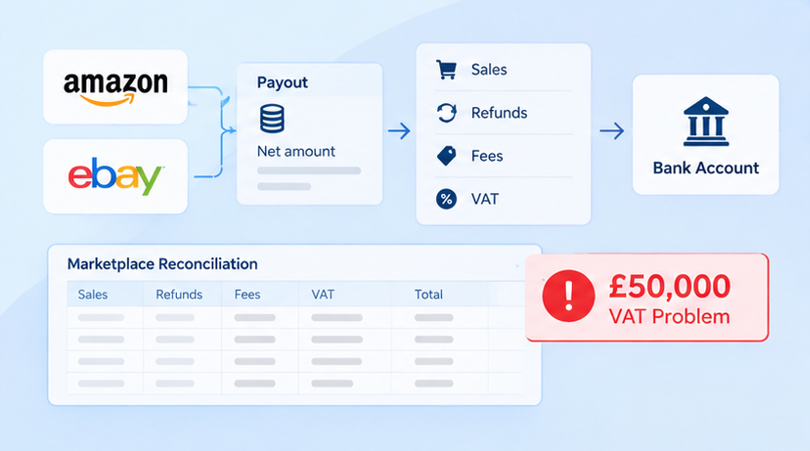
Marketplace sales → Amazon/eBay deductions → Net payout → Bank account → Accounting records
The business was effectively using the amount arriving in the bank as the sales figure.
For a growing ecommerce business, this can appear sensible.
But a marketplace payout is not necessarily the same thing as the underlying sales activity.
Amazon and eBay may deduct commissions, selling fees and other amounts before paying the remaining balance to the seller.
For VAT purposes, the business needs to properly identify the underlying supplies, the consideration received, the VAT treatment and the separate costs or deductions involved.
HMRC’s VAT guidance requires businesses to keep appropriate records and apply the correct VAT treatment to their sales.
The £50,000 VAT problem
Over time, recording marketplace payouts rather than properly accounting for the underlying transactions contributed to a significant VAT shortfall.
By the time the issue was identified, the potential VAT exposure was approximately £50,000.
What started as a bookkeeping process became a substantial tax compliance issue.
And this is one of the most important lessons for ecommerce businesses:
Your marketplace payout is not a substitute for properly accounting for your marketplace transactions.
The accounting records need to explain what was sold, how much the customer paid, what VAT treatment applied, what the marketplace deducted and what amounts were separately recoverable or payable.
Why marketplace fees matter
Suppose a customer pays £120 for a product.
The marketplace subsequently deducts £20 in fees and pays £100 into the business bank account.
The £100 bank receipt does not, by itself, explain the underlying transaction.
There may be:
- £120 of customer sales
- VAT treatment applicable to the sale
- £20 of marketplace fees
- VAT potentially applicable to those fees
- £100 net settlement received
- refunds, adjustments or other marketplace transactions
The accounting system therefore needs to capture and reconcile the underlying activity rather than simply treating the bank settlement as turnover.
The exact VAT treatment will depend on the circumstances, including the nature and location of the supply, the seller’s status and the particular marketplace arrangement.
HMRC can now receive information from digital platforms
There is another reason ecommerce businesses should take their marketplace records seriously.
UK digital-platform reporting rules came into effect from 1 January 2024. Platforms may be required to collect information about sellers and report information to HMRC. The first reporting period covered 2024, with reports due by 31 January 2025.
The information reported can include seller details, transaction information, amounts paid and deductions such as fees, commissions or taxes.
This does not mean that HMRC automatically treats marketplace reporting data as the business’s taxable turnover, nor does the reporting system itself determine a seller’s VAT liability.
But it does mean ecommerce businesses have another important source of third-party data that can be relevant when HMRC checks whether the business’s records and tax returns are accurate.
For a VAT-registered business, this makes proper reconciliation between marketplace reports, accounting records and VAT returns increasingly important.
The input VAT issue
There is another important part of this case.
When the original transactions are reviewed properly, there may also be input VAT that could potentially be recoverable, subject to the normal VAT recovery rules and the business being able to provide the required evidence.
This is why simply looking at the additional VAT liability does not necessarily tell the whole story.
The business may have correctly incurred VAT on qualifying business expenses, marketplace fees or other costs, but if those transactions were not properly recorded and supported, the ability to recover that VAT can become an issue during an HMRC review.
In this case, part of the work is therefore not simply establishing the additional VAT liability.
It is also identifying and supporting the input VAT that should be considered under the normal recovery rules.
This distinction can be significant.
The bigger lesson for Amazon and eBay sellers
The underlying problem was not necessarily that the business was deliberately trying to understate its sales.
The process simply followed what appeared to be the most obvious number:
“This is what Amazon and eBay paid into the bank.”
But ecommerce accounting is more complicated than matching bank receipts.
A proper ecommerce accounting process should consider the underlying marketplace transactions and reconcile them through to the accounting system and VAT returns.
Depending on the business, this can include:
- Amazon transaction reports
- eBay transaction reports
- Gross customer sales
- Marketplace commissions and fees
- Refunds and returns
- Discounts and adjustments
- VAT charged on sales
- VAT on qualifying business expenses
- Import VAT and customs documentation where relevant
- Marketplace settlements
- Bank receipts
- VAT return figures
The exact process will depend on how the business operates and the VAT treatment applicable to its transactions.
A simple question every ecommerce business should ask
If you sell through Amazon, eBay, Etsy or another marketplace, ask yourself:
Can I trace the figures on my VAT return back to the underlying marketplace transactions?
Not just the bank statement.
Not just the amount Amazon or eBay paid you.
The underlying transactions.
If the answer is no, it may be worth reviewing the bookkeeping and VAT process before a relatively simple reconciliation problem becomes a much larger compliance issue.
What we help ecommerce businesses with
At Prime Consultants, we help UK ecommerce businesses establish accounting and VAT processes that are designed around the way their businesses actually operate.
Our support can include:
- Ecommerce bookkeeping
- Amazon accounting
- eBay accounting
- Marketplace transaction reconciliation
- VAT return preparation and submission
- VAT compliance reviews
- Input VAT review and reconciliation
- Import VAT reconciliation
- Accounting system setup
- Ongoing ecommerce accounting support
The objective is not simply to submit a VAT return.
It is to make sure the underlying records give you a reliable picture of your business and provide a clear audit trail for the figures being reported.
Client Story Disclaimer
This article is based on a real-world client situation. Identifying details have been omitted or changed for confidentiality. The approximately £50,000 figure and the circumstances described should be verified against the underlying client records before publication. VAT treatment depends on the facts of each transaction and the rules applicable at the relevant time. This article is for general information and does not constitute tax or legal advice.