
Running an ecommerce business can look simple from the outside.
A customer places an order, the marketplace collects the money, the product is shipped and a payment eventually reaches your bank account.
But from an accounting perspective, that bank payment is only one part of the transaction.
For a growing UK ecommerce business, proper accounting needs to bring together sales, refunds, marketplace fees, payment processing charges, VAT, inventory, imports, advertising costs, supplier purchases and cash movements.
This becomes particularly important when a business sells through platforms such as Amazon, eBay, Shopify or Etsy, because the money received by the business may already have been reduced by fees, refunds or other deductions.
The result is that ecommerce accounting is more than recording money coming into and going out of the bank.
A good ecommerce accounting system should help you answer questions such as:
- How much did we actually sell?
- How much VAT is included in our sales?
- How much did Amazon or another marketplace deduct?
- What did each product actually cost us?
- How much stock do we have?
- What is our genuine gross profit?
- How much cash should we have?
- Which products are profitable?
- How much money is tied up in inventory?
- Are our VAT records complete?
- Are our marketplace settlements properly reconciled?
This guide explains the accounting areas UK ecommerce businesses should understand as they grow.
What is ecommerce accounting?
Ecommerce accounting is the process of recording, reconciling and reporting the financial activity of an online business.
It includes the same fundamental accounting principles that apply to other businesses, but ecommerce businesses often have additional layers of complexity.
For example, an ecommerce business might have:
- Amazon sales
- eBay sales
- Shopify sales
- PayPal or Stripe payments
- Bank transactions
- Amazon FBA fees
- Marketplace commissions
- Advertising costs
- Refunds
- Customer returns
- Supplier invoices
- Import VAT
- Customs charges
- Inventory held in warehouses
- Inventory held by Amazon FBA
- Multiple currencies
- Multiple sales channels
These transactions need to be brought together into an accounting system that produces reliable financial information.
The objective is not simply to make the bookkeeping balance.
The objective is to create records that allow the business owner to understand sales, costs, VAT, stock, cash and profitability.
Why ecommerce bookkeeping can be different from traditional bookkeeping
A traditional small business might receive £1,000 from a customer and record a £1,000 sale.
An ecommerce marketplace can work very differently.
Imagine an Amazon customer purchases products worth £10,000 during a period.
Amazon may then deduct amounts for fees, refunds, fulfilment, advertising or other charges before transferring money to the seller.
The bank might therefore show a payment of £7,800.
If the bookkeeping system simply records the £7,800 bank receipt as sales, the accounts may not accurately represent what happened.
The business has potentially combined several different accounting events into one bank transaction.
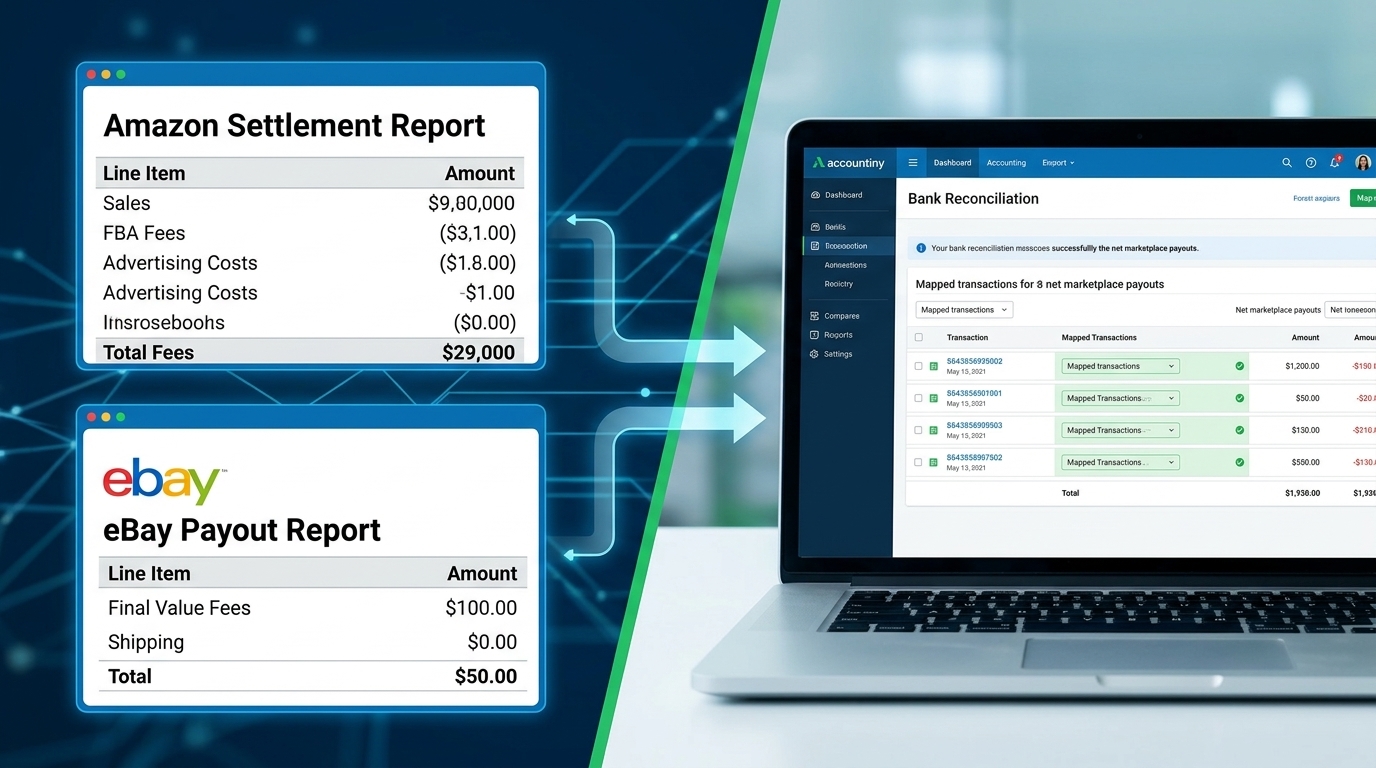
A better approach is to reconcile the marketplace activity so that the accounting records can distinguish between relevant sales, refunds, fees and the eventual settlement.
This is one reason why ecommerce businesses often need a bookkeeping process built around marketplace reports and reconciliations, rather than relying only on bank feeds.
The six areas every growing ecommerce business should understand
Although every business is different, ecommerce accounting usually revolves around six connected areas:
- Sales
- Marketplace fees and other expenses
- VAT
- Inventory
- Bank and marketplace reconciliation
- Management reporting and profitability
Let’s look at each one.
1. Ecommerce sales accounting
The first question is simple:
What did the business actually sell?
That sounds obvious, but the answer can become complicated when the business operates across multiple platforms.
A seller might have:
- Amazon UK sales
- Amazon international sales
- eBay sales
- Shopify sales
- Direct website orders
- Wholesale orders
- Trade sales
Each channel may have different reporting formats and different deductions.
Your accounting records should therefore make it possible to identify the underlying sales activity rather than simply recording the net cash received.
Gross sales versus net settlement
Suppose an ecommerce business makes £20,000 of customer sales through a marketplace.
The marketplace deducts £3,000 in fees and other charges and transfers £17,000 to the bank.
The accounting question is not simply:
“Why did £17,000 arrive in the bank?”
The business needs to understand the relationship between the underlying transactions and the settlement.
A simplified illustration could look like this:
| Transaction | Amount |
| Customer sales | £20,000 |
| Refunds | (£500) |
| Marketplace fees | (£2,500) |
| Other deductions | £0 |
| Net settlement | £17,000 |
The exact accounting treatment depends on the transactions and VAT position, but the important principle is that the bank settlement should be reconciled to the underlying marketplace activity.
This is particularly important for VAT-registered businesses.
HMRC’s current guidance confirms that digital platform reporting does not replace a seller’s normal business records or tax calculations. Platform reports may provide information about amounts earned and deductions, but the seller still needs to maintain appropriate records.
2. Marketplace fees need their own accounting treatment
Marketplace businesses can incur many different charges.
Depending on the platform and the seller’s arrangements, these might include:
- Referral or commission fees
- Fulfilment fees
- Storage fees
- Advertising
- Subscription fees
- Payment processing charges
- Refund-related fees
- Removal or disposal fees
- Currency conversion charges
- Other marketplace services
Amazon’s current UK information, for example, distinguishes between fulfilment, storage and other selling-related costs. FBA fulfilment fees depend on the product and fulfilment method, while storage fees are based on inventory held in Amazon fulfilment centres.
These costs should not simply disappear inside a net bank receipt.
For management accounts, the business owner may want to know:
How much does it actually cost to generate each £1 of sales?
That requires visibility over the costs being deducted before the money reaches the bank.
3. Ecommerce VAT is more complicated than simply adding 20%
VAT is one of the areas where ecommerce businesses can get into difficulty.
The standard VAT rate is currently 20%, but the applicable treatment depends on the goods or services and the circumstances of the supply.
For ecommerce businesses, VAT analysis can involve questions such as:
- Is the business VAT registered?
- Where are the goods located when sold?
- Where is the customer located?
- Is the sale made through an online marketplace?
- Is the customer a consumer or VAT-registered business?
- Are goods imported?
- Is import VAT involved?
- Is the transaction a return or refund?
- Is the sale zero-rated, reduced-rated, standard-rated or exempt?
- Is the marketplace responsible for accounting for VAT in a particular transaction?
For overseas sellers and marketplace transactions, the VAT position can be particularly important.
HMRC has specific rules covering goods sold through online marketplaces, including circumstances where the marketplace may be liable for VAT on certain sales involving overseas sellers. The treatment depends on factors including where the seller is established, where the goods are located and, for certain goods outside the UK, the value of the consignment.
This is why an ecommerce bookkeeping system should not simply assume:
Sales × 20% = VAT.
The underlying transaction needs to be understood.
4. Inventory is part of the accounting picture
One of the biggest differences between many ecommerce businesses and service businesses is inventory.
If an ecommerce company purchases £100,000 of products during the year, that does not necessarily mean the entire £100,000 should automatically become the cost of products sold for the period.
Some of those goods may still be sitting in:
- The owner’s warehouse
- A third-party fulfilment centre
- Amazon FBA
- Another logistics provider
- Transit
- Another storage location
Inventory therefore needs to be considered alongside purchases and sales.
A simple example
Imagine an ecommerce company purchases £100,000 of stock.
At year-end:
- £25,000 of stock remains unsold
- £75,000 relates to products sold during the period
The accounting treatment needs to distinguish the inventory remaining from the cost attributable to goods sold.
The exact accounting treatment will depend on the business structure, accounting framework and circumstances, but the underlying principle is important:
Purchasing stock is not the same thing as consuming or selling that stock.
This matters because otherwise a business owner can receive a misleading picture of gross profit.
5. Gross profit is more useful than simply looking at sales
A common mistake is to judge an ecommerce business by revenue alone.
Suppose two products each generate £100 of sales.
Product A costs £30 to purchase.
Product B costs £60 to purchase.
If marketplace and fulfilment costs are also different, the two products can have dramatically different profit margins.
A business generating £1 million in sales can still have serious profitability problems if:
- Product margins are too low
- Marketplace fees are high
- Advertising costs are excessive
- Returns are high
- Fulfilment costs are increasing
- Stock is becoming obsolete
- Currency costs are significant
This is why ecommerce management accounts should ideally provide information beyond turnover.
Useful measures can include:
- Revenue
- Cost of goods sold
- Gross profit
- Gross margin
- Marketplace fees
- Advertising
- Fulfilment costs
- Operating expenses
- Net profit
- Stock value
- Cash position
6. Marketplace reconciliation
This is one of the most important controls for an ecommerce business.
A reconciliation asks:
Can we explain how the activity reported by the marketplace connects to the amount that ultimately reached our bank?
For example:
Marketplace activity
↓
Customer sales
↓
Refunds/returns
↓
Marketplace fees
↓
Other adjustments
↓
Settlement
↓
Bank receipt
If this chain cannot be explained, the bookkeeping may not be complete.
What should be reconciled?
Depending on the platform and accounting system, you may need to reconcile:
- Sales
- Refunds
- Fees
- Advertising
- Fulfilment
- Other deductions
- Settlement amounts
- Currency movements
- Transfers between accounts
A bank reconciliation answers:
“Does the accounting bank balance agree with the bank?”
A marketplace reconciliation asks a different question:
“Can we explain the marketplace activity that produced the settlement?”
Both can be necessary.
Ecommerce accounting and digital platform reporting
UK digital platform reporting rules are another reason for ecommerce sellers to keep accurate records.
Under the UK rules introduced from 1 January 2024, relevant digital platform operators may need to collect and report seller information and income information to HMRC.
For goods sellers, there is a reporting exception where the seller makes fewer than 30 sales and receives less than €2,000 (approximately £1,700) for those sales in the relevant calendar year.
However, a platform reporting information to HMRC does not automatically mean the seller owes tax.
HMRC explicitly states that platform reports do not replace normal business records or tax calculations.
For an ecommerce business, this makes accurate bookkeeping even more important.
The business should be able to explain its sales and income using its own accounting records.
What ecommerce businesses should keep records of
VAT-registered businesses have specific record-keeping requirements.
HMRC says VAT records generally need to be retained for at least six years, and the records required depend on the nature of the business. Relevant records can include purchase and sales records, invoices, orders, delivery notes and the VAT account.
For an ecommerce business, practical records may include:
Sales records
- Marketplace sales reports
- Website orders
- Sales invoices
- Credit notes
- Refund records
- Returns
Expense records
- Supplier invoices
- Amazon/eBay/other marketplace invoices
- Advertising invoices
- Software subscriptions
- Fulfilment invoices
- Warehouse invoices
- Professional fees
Inventory records
- Purchase records
- Stock reports
- FBA inventory reports
- Warehouse reports
- Stock adjustments
- Damaged or written-off stock
VAT and customs records
- VAT returns
- VAT account
- Import documentation
- C79 certificates where applicable
- Postponed import VAT statements where applicable
- Customs records
The exact record set should reflect the business’s activities.
What happens when an ecommerce business uses multiple sales channels?
This is where accounting systems can become messy.
Imagine a business selling through:
- Amazon
- eBay
- Shopify
- Etsy
Each platform can have its own:
- Sales reports
- Fee reports
- Settlement schedules
- Refund processes
- Currency arrangements
- Tax information
Trying to manually combine everything at year-end is risky.
A better process is to establish a consistent monthly or periodic reconciliation process.
For example:
Amazon
Sales → refunds → fees → settlement → bank
eBay
Sales → refunds → fees → settlement → bank
Shopify
Orders → payment processor → fees → bank
The accounting system can then bring the channels together for management reporting.
Why monthly bookkeeping matters for ecommerce businesses
Some ecommerce owners only become concerned about their accounts when the year-end deadline approaches.
That can be a problem.
If bookkeeping is updated monthly, the business owner can identify issues earlier.
For example:
- A product’s margin may be falling.
- Amazon fees may have increased.
- Advertising costs may be too high.
- Inventory may be accumulating.
- A VAT treatment may need review.
- A marketplace settlement may not reconcile.
- Cash may be falling despite strong sales.
Waiting until year-end means the opportunity to correct the problem may have already passed.
Monthly bookkeeping is therefore not simply an administrative exercise.
It can become a management tool.
Ecommerce accounting should connect profit with cash
One of the most confusing situations for ecommerce businesses is:
“Sales are increasing, so why is there not more cash in the bank?”
There can be several reasons.
The business may be:
- Buying more inventory
- Holding more stock
- Spending heavily on advertising
- Paying marketplace fees
- Funding customer returns
- Paying suppliers before receiving marketplace settlements
- Expanding into new markets
- Paying import VAT and customs costs
- Investing in additional fulfilment capacity
This is why a profitable ecommerce business can still experience cash-flow pressure.
Accounting should help the owner understand the difference between:
Profit
and
Cash available today.
They are related, but they are not the same thing.
Common ecommerce accounting mistakes
1. Recording only bank receipts as sales
This can hide marketplace fees, refunds and other transactions.
2. Treating all purchases as immediate expenses
Inventory accounting may require stock held at the reporting date to be considered separately.
3. Ignoring marketplace fees
Fees can represent a substantial part of the cost of selling online.
4. Failing to reconcile marketplace settlements
A bank reconciliation alone does not necessarily explain the underlying marketplace activity.
5. Using the wrong VAT treatment
VAT treatment can depend on the seller, customer, location of goods, marketplace involvement and nature of the transaction.
6. Ignoring imports
Import VAT and customs records need to be considered where goods are brought into the UK.
7. Mixing personal and business transactions
This makes bookkeeping and financial reporting more difficult.
8. Waiting until year-end
By then, accounting problems may have accumulated across thousands of transactions.
An ecommerce accounting checklist
A growing ecommerce business should periodically ask:
Sales
- Are all sales channels included?
- Are sales reports available?
- Are refunds recorded correctly?
- Are marketplace settlements reconciled?
VAT
- Is the VAT treatment appropriate?
- Are sales correctly classified?
- Are refunds handled correctly?
- Are import VAT records available where relevant?
- Are marketplace-specific VAT rules being considered?
Expenses
- Are marketplace fees recorded?
- Are advertising costs recorded?
- Are fulfilment costs recorded?
- Are software subscriptions recorded?
- Are supplier invoices complete?
Inventory
- Do we know how much stock we hold?
- Does the accounting system agree with inventory records?
- Is Amazon FBA stock included where appropriate?
- Are damaged or obsolete goods identified?
Reporting
- Do we know gross margin?
- Do we know net profit?
- Do we understand cash flow?
- Can we identify our most profitable products?
- Can we explain major differences between marketplace reports and bank receipts?
When should an ecommerce business use a specialist ecommerce accountant?
You do not necessarily need a specialist ecommerce accountant from day one.
However, the need for specialist support often becomes more relevant as complexity increases.
For example, you may benefit from specialist accounting support if you:
- Sell across multiple marketplaces
- Are VAT registered
- Use Amazon FBA
- Import stock
- Hold significant inventory
- Sell internationally
- Have large volumes of transactions
- Use multiple payment processors
- Need monthly management accounts
- Are unsure whether your marketplace settlements reconcile
- Are preparing for a VAT review
- Want clearer product-level or channel-level profitability
The key question is not simply:
“How much do I sell?”
It is:
“How complicated are my transactions, and can my accounting system explain them?”
How Prime Consultants can help ecommerce businesses
Prime Consultants works with UK ecommerce businesses that need more than basic bookkeeping.
Support can include:
- Ecommerce bookkeeping
- Marketplace reconciliation
- VAT return preparation
- Ecommerce VAT support
- Amazon accounting
- Import VAT accounting
- Management accounts
- Year-end accounts
- Tax compliance
- Financial reporting
The objective is to give the business owner accounting records that are useful for both compliance and decision-making.
If your ecommerce business is growing but your bookkeeping still relies heavily on spreadsheets, manual reconciliations or unexplained marketplace deposits, it may be time to review the system.
If you sell through Amazon, eBay, Shopify, Etsy or other online channels and want your accounting records properly organised, contact Prime Consultants to discuss your requirements.
Final thoughts
Ecommerce accounting is not simply about recording money received into the bank.
A reliable system should connect:
Sales → refunds → marketplace fees → settlements → bank → VAT → inventory → cost of sales → profit → cash flow.
When those pieces are connected, the accounts become much more useful.
You can see where your money is going, understand your margins, identify problems earlier and make decisions using financial information rather than guesswork.
For a growing ecommerce business, that can make the difference between simply tracking transactions and actually understanding the business.
Prime Consultants provides UK-focused accounting support for ecommerce businesses, online sellers and marketplace businesses.

